Monday, July 03, 2006
Holy Joe goes indy
Joe Lieberman will continue to run in the Democratic primary, while announcing that he doesn’t plan to abide by its results, running as an “independent Democrat” (that is, independent of the Democratic electors of his state) if he loses (which he says is possible because it might be hot that day). He says, “While I believe that I will win the Aug. 8 primary, I know that there are no guarantees in elections.” He says that – “there are no guarantees in elections” – like it’s a bad thing.


Sunday, July 02, 2006
Rain, rain, go away
Israel is calling its collective punishment of Gaza “Operation Summer Rains.” Dude, that ain’t rain!
Intensify
Oh dear, I just can’t think of a single sarcastic thing to say about this NYT headline: “Cheney’s Heart Condition Is Called Stable.”
Olmert has ordered the military to “intensify” its activities in Gaza. What’s left? Poisoning wells? Kicking dogs? Popping children’s balloons?
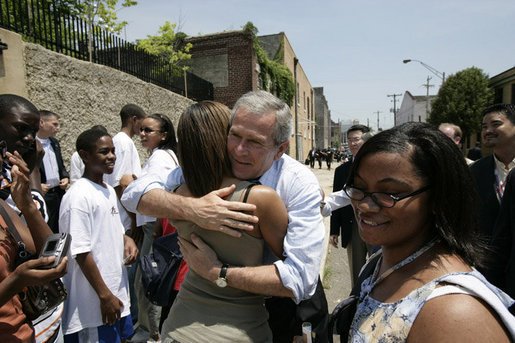
Bush and Koizumi didn’t just go to Graceland on Friday, but also to the National Civil Rights Museum, where he decided to try out a “replacement” for Condi, if you know what I mean. Dude, that is so, so wrong.
Saturday, July 01, 2006
More words to add to the 999,850 George Bush doesn’t know
Sen. Ted Stevens (R-Senile Dementia) explains how the internet works (evidently it’s a series of tubes) and why he won’t vote for Net Neutrality (because someone sent him an internet and it took several days to reach him).
Time magazine has an article about prisoners and hunger-strikes in Guantanamo, which explains why I’ve been getting all those hits from people googling “padded cell on wheels” today (this February post, which has pictures of the contraption). Readers of this blog will find nothing new in the article, and a certain amount of laziness (it says that in the “1980s,” “several” IRA prisoners hunger struck and a “handful” died). So why am I mentioning it? Er, good question. Moving on...
I’ve been thinking about the word “arrest.” A couple of days ago, Eli at LeftI made a point that I’ve made before, in relation to the actions of both Israelis in Palestine and Americans in Iraq, that they aren’t “arresting” people but capturing or seizing or kidnapping them, because arrests are done under some system of law. Suskind’s book mentioned parenthetically that when thousands of Arabs & Muslims were rounded up in the US after 9/11, “it was clear that the ratio of arrest to prosecution would be more out of sync than at any time in [FBI] history.” It occurred to me that the purpose of arrest had changed to such an extent that it did violence to the English language and to the concept of a rule of law to continue to use the word. If an arrest is no longer a preliminary to prosecution, it becomes an end in itself. The end is not the law, and the “law enforcement” agencies are no longer about enforcing laws. Police without law is the definition of a police state. Maybe the FBI needs breaking up if it is to be both a law-enforcement agency and a secret police.
Also, someone should revive “Arrested Development.” That was a good show.
A good WaPo Style Invitational, suggestions for the one millionth word in the English language. Some of the entries:
Percycution: Giving your child a name he will hate for the rest of his life.
Martyration: A request for only 36 virgins in paradise.
Achoodication: Trying to determine whether you have to say "bless you" after someone’s second sneeze.
Banglion: The primitive neural structure constituting 90 percent of the male brain.
Codgertation: A man’s realization that with a certain saying, thought or action, he has turned into his father.
Immigaytion: The GOP’s two-pronged fear strategy: "It’s two, two, two horrors in one!"
Racquisition: Implant surgery.
Regattacotillion: A vocabulary word designed solely to discriminate against minorities on standardized tests.
Regeorgitation: When the vending machine spits back your dollar bill.
No exit?
I’m not sure what Israel’s exit strategy is. Israel is entirely capable of kidnapping people explicitly for the purpose of exchanging them for captured Israeli military personnel (as in the case of Ron Arad), but it claims that the seizing of 8 Palestinian cabinet officials and however many MPs is not to swap them for Shalit, but because they’re terrorists. They were all taken in for questioning. Israel is evidently willing to... well, you don’t need me to list all the things they’ve done to Gazans... but not willing to admit to having responded to hostage-taking by taking hostages. Or something; trying to work out their logic makes me queasy. But if Israel won’t admit to seizing them in order to exchange them for Shalit, how can it manage the logistics of actually making that exchange?
The kidnappers, who keep making demands they can’t expect to be met, don’t seem to have a viable exit strategy either. So this should all turn out well.
A little detail from the WaPo: the Gaza power plant was ensured by the United States government, for $48 million.
The kidnappers, who keep making demands they can’t expect to be met, don’t seem to have a viable exit strategy either. So this should all turn out well.
A little detail from the WaPo: the Gaza power plant was ensured by the United States government, for $48 million.
Friday, June 30, 2006
Welcome to my blog: providing you with a kind of information radar to better understand the information battlespace
Cecilia Fire Thunder, the Sioux council president who offered to host an abortion clinic on her reservation in response to the SD abortion ban, has been impeached by the council for going beyond her authority.
The military tribunals at Guantanamo are supposed to contact witnesses who prisoners wish to call. They don’t. They make minimal or no effort to find them, and have never flown a witness in to testify. In one case, the Guardian found all 4 witnesses an Afghan prisoner wanted in 3 days (one was dead, one worked for Karzai, one is teaching in Washington DC). It’s called Google, baby.
Of course the Pentagon may be a little behind the curve on such things. It just launched a three-year, $450,000 study to figure out just what these “blog” things are, anyway. Says one guy associated with the project, “Our research goal is to provide the warfighter with a kind of information radar to better understand the information battlespace.” Hey, don’t laugh, he figured out how to make money off of blogs.
Russia is holding up the paper work of 40 foreign NGOs forced to “register” under new laws. Also, the Duma has passed (in its first reading) a bill banning “extremism,” which is defined as “interfering with the legal duties of organs of state authorities,” whatever that means (whatever Putin wants it to mean, of course), or “public slander directed toward figures fulfilling the state duties of the Russian Federation.” Journalists could be imprisoned for 3 years for that and their papers closed down. Political parties could be dissolved for it. Further along is a bill to scrap the “none of the above” option on Russian ballots that made them so much fun (candidates had to win 50% of the total vote).
A “Suskind offering”: Ron Suskind’s The One Percent Doctrine
I’ve finished Ron Suskind’s The One Percent Doctrine: Deep Inside America’s Pursuit of Its Enemies Since 9/11, and I’m not overwhelmed, more average-to-middling-whelmed (but if you still want to buy it after reading my review, do click here for my Powell’s link or here for my Amazon.com link. I get like 80¢ if you do. Or try your public library; I had this copy 3 days after I put a hold on it).
It’s a 350-page book that would have been better, if less lucrative, as a long New Yorker article. Like other books by reporters, it’s hard to judge how seriously to take its revelations without knowing who his sources are, and indeed who his sources aren’t – his insights into the thinking of Acting President Cheney may be the most important part of the book, but I’ll bet he wasn’t able to interview the man.
(I wrote that part last night. Today the Columbia Journalism Review website has an interview with him, and dear God what a self-important, pompous man he is. I couldn’t have brought myself to read the book if I’d read that interview first. He admits that the reader must take on faith that he has talked with enough of the right anonymous people and that he is able to take account of their biases and agendas and get the story right. But, dammit, people love and trust him, he says: “I think over time readers are saying, okay, this is a Suskind offering, this is what he does. It’s more vivid, it moves.” Now how you can trust that his quotes from Bush and Cheney are accurate when he thinks that that’s what his readers are saying? I don’t think he realizes that the trust he’s asking us to place in his judgment and his character exactly mirrors the trust Bush demands as his due.)
The book’s title refers to the belief among the Bushies that the stakes are so high in The War Against Terror (TWAT) that it is permissible to act to prevent events that there is very little proof will actually happen, such as Pakistan’s A.Q. Khan network passing nuclear technology to Al Qaida. Can’t have the smoking gun be a mushroom cloud, and all that. “Suspicion... became the threshold for action.” Suskind seems to have spoken mostly with CIA sources, who are interested in reasserting the importance of factual analysis and, let’s face it, in covering their asses.
By the way, the book’s famous Bush quote, after Tenet sent a briefer to Crawford in August 2001 to make sure Bush got the point that bin Laden was determined to attack inside the United States, “All right, you’ve covered your ass, now”: the real significance isn’t just that Bush dismissed it, but that for him, the point of intelligence briefings wasn’t to provide a basis for action; rather, that he considered them a form of bureaucratic ass-covering.
The most interesting thing about the book is the way in which 1) Cheney’s plans, dating back to the Ford administration, to strengthen the executive branch, 2) Bush’s intellectual laziness, and 3) the “new type of war” against shadowy terrorists, all came together to reinforce each other and create the new model of government we have today. Suskind writes,
The Cheney Doctrine released George W. Bush from his area of greatest weakness – the analytical abilities so prized in America’s professional class – and freed his decision-making to rely on impulse and improvisation to a degree that was without precedent for a modern president. Cheney essentially crafted a platform, an architecture, for Bush to be Bush, while still being President.The Cheney Doctrine – “It’s not about our analysis, or finding a preponderance of evidence. It’s about our response.” (that’s another maybe-quote) – is a perfect fit with a president who’s all about response and not at all about analysis, but it was The War Against Terror (TWAT) that raised the stakes and the uncertainty and paranoia and fear so that that recklessness could seem like a reasonable response.
On the one hand, crucial facts were routinely, Suskind says, kept away from Bush by Cheney, so that Bush could stick to the agreed narrative in public with plausible deniability and without being confused by the facts. Suskind, in another significant-if-true revelation, says that when Bush met with Saudi Crown Prince Abdullah in April 2002 to try to get Saudi Arabia to cooperate against Al Qaida, he hadn’t seen, and evidently didn’t know about the existence of, the prince’s set of demands, mostly relating to Israel, because Cheney had diverted them to his office. The prince went away rather confused.
There many interesting things in the book, and fragments of interesting things, including a discussion of how to get authoritarian rulers (like Gadhafi) to do what the US wants, when their power depends on not losing face. We have a terrorist policy, Suskind says, but not a dictator policy. And there are many of those significant-if-true quotes and facts which I simply don’t know how to use because I’m not inclined to put blind trust in Suskind. Like a George Bush speech, it’s likely to be believed by the sorts of people who are inclined to believe it, but not to convince anyone else.

Thursday, June 29, 2006
It was not always a given that the United States and America would have a close relationship
Bush thinks there is peace in southern Sudan (not Darfur). Told by the BBC’s Sudan reporter that the 2005 peace accord was not being honored by the government, he said, “That is not the information I’m getting.” That’s because it wasn’t extensively covered by Teen People magazine.
Salon finds proof of what Jane Mayer wrote last year (which they mentioned but didn’t link – bad Salon!), that the Pentagon’s how-to-survive-torture class was also used to train Guantanamo interrogators.
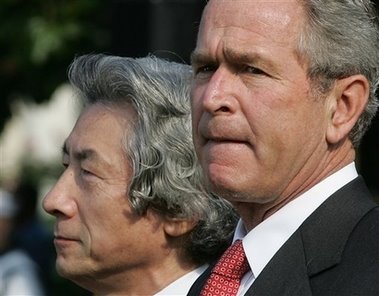
Bush met with Japanese Prime Minister Koizumi today. Bush told him “it was not always a given that the United States and America [sic] would have a close relationship.” Indeed, some would call the relationship between the United States and America an abusive relationship.
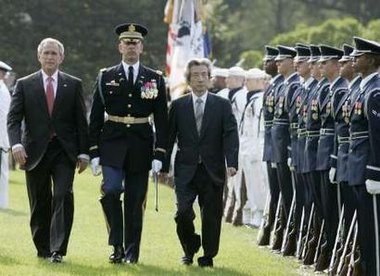
Here’s how Bush spun Japan’s decision to pull its troops out of Iraq: “And they’re able to leave because they did such a good job.”

He talked about how he’d met a Japanese woman whose daughter had been abducted by the North Koreans. “It also reminded me about the nature of the regime -- what kind of regime would kidnap people, just take them off offshore, you know”. Um, hello? Guantanamo?
Hamdan v. Rumsfeld: How will Bush save us from the jayhawkers now?
The Supreme Court rules (pdf) in Hamdan v. Rumsfeld that “The Court’s conclusion ultimately rests upon a single ground: Congress has not issued the Executive a ‘blank check.’” Could have fooled me. Note that what made Bush’s military tribunals illegal under both US military law and the Geneva Conventions was that the defendant had no right to see the evidence against him.
There’s an interesting nugget in Thomas’s dissent: according to Bush, the current state of war began (and this matters legally because Hamdan is charged with acts occurring before 9/11) with a declaration of war by Al Qaida in August 1996.
Clarence Thomas, who used not to like high-tech lynchings, believes Hamdan can be tried by military tribunal because Al Qaida is analogous to “banditti, jayhawkers, guerillas, or any other unauthorized marauders.” It’s always nice to see the term jayhawker bandied about. Very Ken Burns-y. What it comes down to is Thomas’s belief that Hamdan can be tried by a military tribunal because he is presumed guilty of “conspiracy to massacre innocent civilians,” and we know this because the Bush administration has accused him of it. Quod erat demonstrandum. He adds that this decision will “sorely hamper the president’s ability to confront and defeat a new and deadly enemy.” Jayhawkers.
Wednesday, June 28, 2006
We must stop the desecration of the white flag of surrender
In response to the UN conference on illegal arms sales, the US demands there be no restriction on the international sale of ammunition or a ban on selling weapons to rebels fighting governments we don’t like – says the US’s under secretary of state for arms control and international security affairs, Robert Joseph, “we recognize the rights of the oppressed to defend themselves against tyrannical and genocidal regimes.” I’d be interested in a list of governments the US believes it is okay to overthrow. Probably different from my list. Also, isn’t arming such groups illegal in the US? Neutrality Acts, that sort of thing?
So Israel bombed several bridges in Gaza, which sort of has an arguable operational purpose, preventing their captured soldier being moved, although bantustanization is so clearly part of the Israeli strategy for keeping the Palestinian state weak that one assumes it was something they always planned to do given an even slightly plausible excuse. But destroying water and power supplies for the entire Gaza Strip? Seizing the labor minister, deputy prime minister, etc? Buzzing the Syrian presidents’ palace (actually, causing sonic booms overhead)? And after all this time, do the Israelis really think that collective punishment, taking 1.3 million hostages to exchange for 1, will make the Palestinian people blame Hamas rather than Israel and turn against it?
And a word to Hamas, or whoever seized Corporal Shalit: release him, kill him, but do it quickly.
For the second time this month, Bush, who was supposed to restore civility to Washington, has accused “a group in the opposition party” of being “willing to wave the white flag of surrender.” (Politicians are really showing their flag fetishes this week.) Bush was at a “Talent for Senate” fundraising dinner. “Talent for Senate”... nope, can’t think of anything funny or ironic about that. Actually of course that’s Missouri’s Sen. Jim Talent, who looks exactly like the sort of person Bush and his frat buddies liked to beat up.


It occurred to me as I read his words “it’s essential we do not forget the lessons of September the 11th, 2001,” that for someone who invokes it so much, he rarely if ever uses the informal abbreviation 9/11. Maybe he’s waiting for a formal introduction.
You have (inaudible) the Afghan people
Condi Rice was in Afghanistan today. Sometimes a crappy transcript inadvertently contains more truth than a good one. Here she addressed Karzai during a photo op: “you have (inaudible) the Afghan people and indeed to the region and to the world.” She went on, “(Inaudible) reconstruction (inaudible) bring further security to the Afghan people”.
Karzai twice claimed to be able to travel freely in Afghanistan outside of the several square blocks of Kabul he more or less controls. Why he even went to Zabul a while back. Look on my works, ye mighty, and despair!
Condi says that “we made the mistake once before of leaving Afghanistan and of not sustaining our commitment to our relationship here.” In an interview, she adds that “America suffered on 9/11 because we had not stayed committed to Afghanistan”. When were we “in” Afghanistan and what was the nature of our “relationship”? She is referring of course to the CIA’s covert program in support of the Mujahadeen. So was the failure in the 1980s that we didn’t bolster religious zealots long enough, or that we didn’t fill the role of imperial overlord vacated by the Russians?
Tuesday, June 27, 2006
In other words
Bush made a speech today in favor of the latest (obviously unconstitutional) line-item veto proposal. I know he even talks to us like we’re the idiots, but still: “According to the Congressional Research Service, the number of earmarks has increased from about 3,000 to 13,000 over the last decade. In other words, this process is taking place more and more often.”
Then he went jogging with an Iraq War double amputee, Staff Sgt Christian Bagge, who backed Bush into promising to jog with him in January when Bush visited the amputee ward of an army hospital. You’ll remember he then said, “I can’t think of a better way to start 2006 then here at this fantastic hospital.” Bush said that, not Bagge.


If I declare this a caption contest, I’ll really regret it, won’t I? “Then Bush used him to open a giant bottle of Budweiser” – that sort of thing, right? You people disgust me.
Somehow unworthy of a civilized society
In Kansas v. Marsh, the Supreme Court decided that in a death-penalty case, when aggravating and mitigating factors are even, it’s okay to just go ahead and kill the guy. There were long dueling arguments in the opinions about something actually irrelevant to this case, the likelihood of innocent people being executed, which Fat Tony Scalia wrote (pdf, Scalia’s concurring opinion starts on p.22)
“has been reduced to an insignificant minimum” (insignificant!), although “it is easy as pie to identify plainly guilty murderers who have been set free.” For the hell of it, Fat Tony even refers to Sacco and Vanzetti as “supposed innocents.” Scalia also complained that the dissent would give aid and comfort to “sanctimonious criticism [by foreigners] of America’s death penalty, as somehow unworthy of a civilized society” and would be “trumpeted abroad as vindication of these criticisms.”
Speaking of civilized societies, Somalia’s new Islamic rulers have announced their first executions-by-stoning.
Monday, June 26, 2006
Disgraceful
After a very important meeting with Gary Sinese (for whom it must have been very reminiscent of Forrest Gump),
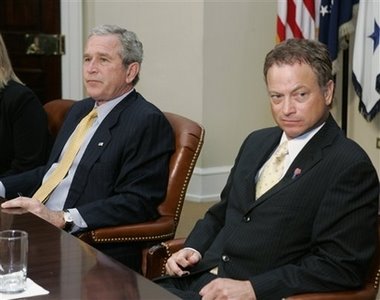
a reporter asked Bush about the leak that Gen. Casey has been talking about a timetable to withdraw a few troops from Iraq. His answer suggests that when he turns 60 this week, his age and his IQ will be identical:
First of all, I did meet with General Casey, and I met with him because it’s very important for me, as well as Secretary Rumsfeld, to meet with our commander on the ground. I’ve told the American people our commanders will be making the decisions as to how to achieve victory, and General Casey, of course, is the lead person. So we had a good visit with him. ... And one of the things that General Casey assured me of is that, whatever recommendation he makes, it will be aimed toward achieving victory. And that’s what we want. ... And so I did visit with General Casey, and I came away once again with my trust in that man. I’ve told the people here around the table that the decisions that I will make will be based upon the recommendations of people like General George Casey.And I actually edited some of the rambling out of that answer.
On the North Korean missile test: “we need to send a focused message to the North Koreans in that this launch is provocative.”
And he said the NYT’s story about the warrantless inspection of banking records was “disgraceful.” Isn’t it fun when Bush tries to scold and shame someone?
Woody Allen discovers Friedrich Nietzsche’s Diet Book. “As we know, for centuries Rome regarded the Open Hot Turkey Sandwich as the height of licentiousness; many sandwiches were forced to stay closed and only reopened after the Reformation.” “The great question of philosophy remains: If life is meaningless, what can be done about alphabet soup?” “‘Order like you are ordering for every human being on earth,’ Kant advises, but what if the man next to you doesn’t eat guacamole? In the end, of course, there are no moral foods—unless we count soft-boiled eggs.”
Sunday, June 25, 2006
OK, folks, every so often I just can’t think of a title
A few hours after the announcement of Maliki’s “reconciliation plan,” video of the murder of 4 abducted Russian embassy workers was posted on the internet. A simple “no” would have sufficed.
The London Times, which saw a draft of it last week, says it’s been vagued up, including the removal of a real timetable, details of un-de-Baathification, and “a call for the Government to recognise the difference between resistance and terrorist groups and a written invitation for resistance groups to join a national dialogue.”
The Chinese legislature decides not to criminalize sex-selection abortions. Which is one of those practices I find morally abhorrent and wouldn’t consider banning for a second. The sort of people whose values would lead them to that act should not be inflicted with a baby girl, or vice versa.
I’ll bet when Bush goes to church, the Secret Service doesn’t let anyone else have an umbrella.

24 points, and a thousand times no
Maliki issues his 24-point plan, marked down from 28. Hurrah! It calls for a timetable for American withdrawal, without actually suggesting one. An amnesty, except for people who committed “criminal and terrorist acts and war crimes.” But jay-walkers need no longer live in fear of a midnight knock on the door. For those others, “we present a fist with the power of law to protect our country and people”; “No and a thousand times no. There can be no deal with them until they have been justly punished.” My impression that Maliki is a bit of a blowhard is not diminishing over time. It’s unclear whether or not the amnesty applies to people who just killed Americans, since the “terrorist acts” thing might or might not include that (depending on whether you ask an American or an Iraqi, really). Also, he didn’t say how they’d determine who had committed those acts which are ineligible for the amnesty. In other words, on this key provision, as on the timetable, he decided to fudge. He says that foreign troops should respect human rights. Rummy says, “Yeah, we’ll get right on that.”
What else? Ensuring the army is run on “professional and patriotic lines,” presumably by professional patriots. Compensation, from who knows what source, for victims of terrorism, ethno-sectarian cleansing, de-Baathification and military operations. Adoption of a rational discourse. National dialogue. A united stand against terrorists. Pretending that Iraq’s elected bodies are solely responsible for decisions regarding Iraq’s sovereignty and the presence of foreign troops. Yet more national dialogue. And then, for dessert, some national dialogue.
What else? Ensuring the army is run on “professional and patriotic lines,” presumably by professional patriots. Compensation, from who knows what source, for victims of terrorism, ethno-sectarian cleansing, de-Baathification and military operations. Adoption of a rational discourse. National dialogue. A united stand against terrorists. Pretending that Iraq’s elected bodies are solely responsible for decisions regarding Iraq’s sovereignty and the presence of foreign troops. Yet more national dialogue. And then, for dessert, some national dialogue.
Saturday, June 24, 2006
Shhh
Letter to the NYT, one of several deploring its publishing of the details of the warrantless surveillance of banking records: “Isn’t the point that the public’s right to know must be balanced against protecting the public at a time of war? I’d rather know that the bad guys were being caught than having my ‘interest’ in this story satisfied over this morning’s cup of coffee.”
And in North Korea, whose citizens haven’t been told of its threat to test a ballistic missile, a waitress tells the Sunday Telegraph: “Our Dear Leader knows what he does, and if it’s necessary to keep something secret, we will.”

Government at its best
Saddam Hussein, unclear on the concept of a hunger strike, skipped exactly one meal to protest the killing of another of his lawyers.
Treasury Sec John Snow says the program of spying on private banking records is “government at its best.” In your face, Social Security!
Incidentally, that program may have been conceived to fight terrorism, but like every other expansion of executive power was immediately put to other uses, against more mundane crimes like money laundering and drugs. Other than that, their examination of millions of money transfers ($6 trillion a day) seems to have netted them one terrorist. Presumably if they ever put anyone on trial with evidence derived from this program, if it were actually effective, it would have all come out anyway, so really everyone can lay off the New York Times (Cheney says the Times’s decision “offends me”).
Meanwhile (is it too suspicious of me to wonder if this was timed to coincide with the NYT story, which they knew about for at least a month?), the FBI arrests a group of Floridian would-be terrorists whose plans were “more aspirational than operational.” Isn’t that the Republican Party motto?
Finally, farewell Harriet, we hardly knew ye.

Subscribe to:
Posts (Atom)

