Saturday, July 08, 2006
Wherein is answered the question, what makes God want to vomit?
Rev. O’Neal Dozier, an ally of Jeb Bush (and of Attorney General Charlie Crist, a candidate to succeed Bush), who I can’t remember hearing of before today but already loathe, has stirred up some controversy by calling Islam a cult religion. Evidently no one’s been much bothered up until now by this guy, appointed (twice) by Jeb to the Broward County Judicial Nominating Commission, asking potential judges if they are god-fearing, how active they are in their church, and what sort of parents they are (a little googling clarifies that he asked that of a single mother). He is on a committee attempting to block the opening of an Islamic center (they’re all terrorists, you know). He’s been to the White House several times. He supports Crist because Jesus came to him in a dream and said Crist would win. Did I mention that this guy screens judicial nominees in Broward County? He has said, “We cannot have a judge who feels sodomy is OK” and that homosexuality is “something so nasty and disgusting that it makes God want to vomit.”
There’s probably a gross theological discussion to be had about whether God could in fact create something so nasty that He couldn’t help but vomit.


Friday, July 07, 2006
It’s a decision-making experience
Bush went to raise funds for Judy Baar Topinka’s campaign for governor of Illinois, where he spoke incoherently about education: “We’ve got too much stateism, in public education, too much excuse-making, too much process.” Too much process? “And the reason we want people to measure is because we want to know.” And there’s something in the transcript which is not Chimpy’s fault but which I still adore: “You know what’s happening here in the city of Chicago? You’re reading scores are up.”
“It’s a decision-making experience. Governor, you’ll find it to be decision-making experience,” he advised Ms. Topinka, who is not the governor. “I love ethanol,” he confided. “I can’t think of a more noble profession than being an OB/GYN,” he said, mysteriously. “I wish WIIIAI would stop taking my comments out of context,” he protested.
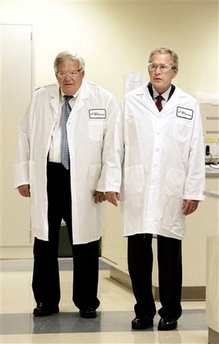
Continuing the education theme, Bush next went on a tour of the Cabot Microelectronics Corporation and he was amazed, simple unabashedly amazed, to find that the people who worked there had studied science:
And what’s amazing as you walk through the labs and meet the people working here, you say, what’s your degree in? Let me just say, there wasn’t a lot of history majors -- physicists, chemists, PhDs., people with advanced degrees. It is clear that in order for this country of ours to be competitive in the future, we’ve got to understand the nature of the jobs of the future, and these jobs are going to require people who have got math and science skills.So future good, past bad, history majors will be heard to mutter, “Worst president since James Buchanan (1857-1861),” as they mop the floors at Cabot Microelectronics.

Bush press conference: words mean different things to different people
Bush had a press conference today, and the gimmick is that it wasn’t in Washington but in Chicago. Which explains the windiness.
On immigration: “And when you make something illegal that people want, it’s amazing what happens -- got a whole industry of smugglers and innkeepers and document forgers that sprung up.” Innkeepers?
On democracy: “You win elections by believing something.” That your brother and Katherine Harris will make sure the votes against you aren’t counted? That you have a lock on the US Supreme Court?
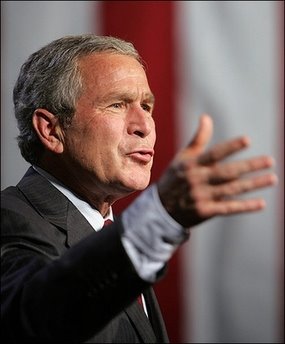
On diplomacy: “It’s kind of painful in a way for some to watch because it takes a while to get people on the same page. Everybody -- not everybody thinks the exact same way we think. There are different -- words mean different things to different people, and the diplomatic process can be slow and cumbersome. This is why this is probably the fourth day in a row I’ve been asked about North Korea -- it’s slow and cumbersome.” Also, of course, other countries aren’t as selfless and altruistic as we are, and clearly when they disagree with American foreign policy it must be because they’re greedy self-interested bastards: “Some nations are more comfortable with sanctions than other nations, and part of the issue we face in some of these countries is that they’ve got economic interests. And part of our objective is to make sure that national security interests, security of the world interests trump economic interests. And sometimes that takes a while to get people focused in the right direction.”

On defining success in a war: “This is a compassionate nation that cares about people, and when they see people die on their TV screens, it sends a signal, well, maybe we’re not winning.”
On defining democracy in Asia: “the region is relatively peaceful except for one outpost; one system that’s not open and transparent; one system that doesn’t respond to the will of the people; one system that’s dark, and that’s North Korea.” It’s official: China is open, transparent and responds to the will of the people. Who knew?
I’d rather be judged as solving problems and being correct, rather than being popular
Bush and the LauraBot were interviewed on his birthday by Larry King, and gosh would you believe that not much of substance got said in an entire hour. Larry must have been hard pressed to restrain himself from singing Happy Birthday, and probably then only because CNN would have had to pay the song’s copyright holders.
But there was time for:
George’s in-depth psychoanalysis of the goals of Kim Jong Il (or as Bush called him, “the person in North Korea”): “You know, I don’t know. I really don’t know. I think he wants us to either fear him or pay attention to him.”
George’s profound understanding of the ramifications of history: “And the reason why I was now able to work with Koizumi to keep the peace and to go to Graceland to honor Elvis, was because Japan adopted a different style of government.”
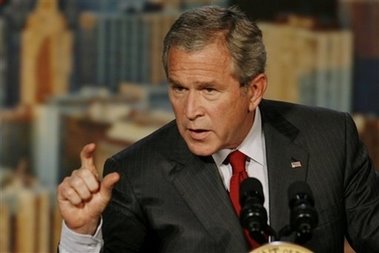
George’s deep sense of his place in history: “When history looks back, I’d rather be judged as solving problems and being correct, rather than being popular.” Yeah, good luck with that.
George’s erudite and compassionate... oh fuck it, roll the tape: “I mean, when you find -- if in fact the charges are true that somebody was raped and murdered, then there ought be concern by the Iraqis. What they’ve got to be comforted in knowing is that we will deal with this in a way that is going to be transparent, above board and open.”
Thursday, July 06, 2006
The Lieberman-Lamont debate
First thought: anyone who uses the “There you go again” line, as Lieberman did a couple of times, should automatically be declared to have lost the debate.
I’m beginning to despise the whole election debate format: “I’m not Bush,”; “I’m one of the senators able to reach across the partisan divide,” but you voted with Republicans on whatever exciting issues the Greenwich board of selectmen voted on; how many times can I, Ned Lamont, say my own name, which is Ned Lamont, in an hour?; you are a one-issue candidate, you have six different positions on that issue (Lieberman didn’t quite use the phrase “flip-flopper,” but you just knew he wanted to), etc. Lamont had a few of those pre-programmed things too, unless you believe that “Sir, this is not Fox News” line was conjured up on the spur of the moment.

At one point, about 35 minutes in (I didn’t write it down and can’t find a transcript), Joementum went over the small-d democratic line, calling into question the legitimacy of anyone running against him in the primary. And in his prepared opening, Holy Joe again said, “Ned Lamont seems just to be running against me based on my stand on one issue, Iraq... applying a litmus test to me,” glibly suggesting that the war isn’t so important an issue that people who disagree with him on it should vote against him because of it. That dismissive treatment of a big, bloody, lengthy, expensive, you know... war, is what disqualifies him from further public service, almost regardless of his actual position on that oh so minor subject.
And there’s all kinds of discussions out of administrations and people saying this, saying that, and the other
AP headline: “Bush: Hard to Read North Korea’s Motives.” Or words of more than two syllables. You were all way ahead of me on that one, weren’t you? (Update: Wonkette was also ahead of me.) (It’s being guest-blogged this week by Princess Sparkle Pony, so it’s actually entertaining for a change).
(And Needlenose is also ahead of me, with a caption contest I was going to have. I must start getting up earlier.)
That comment and that image were in a press “availability” with Stephen Harper of Canada, who gave him a belt buckle and silver cuff links a Mountie hat for his birthday. Since my first contest idea was scuttled, perhaps you’d care to guess what Harper was trying to tell Bush with those gifts? Bush says Harper “tells me what’s on his mind and he does so in a real clear fashion.” As opposed to King Jong Il:
It’s hard for me to tell you what’s on his mind. He lives in a very closed society. It’s unlike our societies where we have press conferences and people are entitled to ask questions, and there’s all kinds of discussions out of administrations and people saying this, saying that, and the other.Especially, in his case, the other. Although he does have a point – we do know exactly what’s on Chimpy’s mind: gibberish.
Bush said over and over that everyone needs to speak (gibberish) to North Korea with one voice. But there can’t be bilateral talks, it has to be 6-party talks. But 5 of the parties are supposed to speak with one voice. Whatever.
Bush also had a meeting with Ambassador Khalilzad. Bush questioned the motives of the insurgents: “And you have to ask yourself, who’s afraid of democracy?” Well....
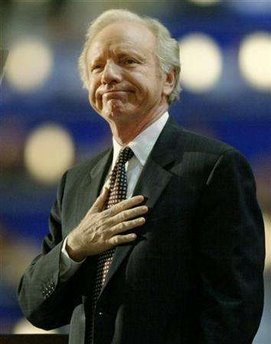
The real problem in Iraq: “Zal is concerned about foreign influences in the country, as am I.” It’s those damned furriners!
Wednesday, July 05, 2006
Accountability
Various members of the Italian intelligence services have been arrested, and warrants issued for 26 American CIA agents and suchlike, for the kidnapping of a Muslim cleric, who was flown from Italy to Egypt for torture. This is the Italian legal system we’re talking about, so I wouldn’t expect too much, but it should be fun while it lasts.
Another lovely quote from Gen. William Caldwell IV about Mahmudiya: “We will hold ourselves accountable for our actions.” But if there’d been a rape and multiple murder and cover-up by Saddam Hussein’s military, he actually did have the gall to go on and say, “there was absolutely no accountability”.

I will now end, like all blog posts should, with a picture of a bear in a convertible.

What these firing of the rockets have done is they’ve isolated themselves further
Bush climbed down on immigration, saying he no longer insisted on a comprehensive plan but would let Congress pass a bill solely to tighten enforcement, and get to the citizenship and guest-worker proposals, you know, later. He made this announcement at a Dunkin’ Donuts, for, um... symbolic reasons? The hole in the middle represents the place his integrity should be? Mexicans will have to swim the Rio Grande like donuts dunked in coffee? Something about dropping g’s at the end of -ing words? He says it’s because “I love being with entrepreneurs and dreamers and doers and people who are running things, and managers”. Dude, it’s a donut store. You know who you meet in those? Some years ago I got to Venice, California a little early for a double feature at the Fox Venice Theater, and decided to kill some time at a donut store. Some big guy with a beard came up to me and started talking about Jesus Christ. Not in a theoretical way: he claimed to actually hang out with Jesus, ride motorcycles together... there was a little hint that they might have had sex, but I didn’t wish to pry. After he’d gone on for a while, I thanked him for sharing, backed out of the store quickly, and went to my Fellini double bill. I imagine the people at the Alexandria Dunkin’ Donuts feel much the same way I felt that night. All except for April Ryan, the White House correspondent for the American Urban Radio Networks, who Bush offered to buy a cup of coffee:
THE PRESIDENT: April, would you like me to buy you a cup of coffee?Ewwww.
MS. RYAN: I would love you to.
THE PRESIDENT: What would you want in it?
MS. RYAN: Anything you want to give me.
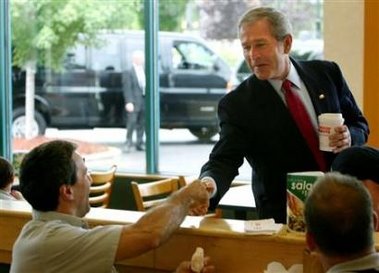
In a photo op later in the day with President of Georgia Saakashvili, Bush was asked about North Korea. He offered that country this helpful advice:
The North Korean government can join the community of nations and improve its lot by acting in concert with those who -- with those of us who believe that she shouldn’t possess nuclear weapons, and by those of us who believe that there’s a positive way forward for the North Korean government and her people. In other words, this is a choice they made.Diagram that first sentence, I dare you. Clearly that Dunkin’ Donuts coffee kept him awake when he should have been taking his late-morning nap. “What these firing of the rockets have done is they’ve isolated themselves further.”
We must remember the acts of a few should not outweigh the deeds of the many
North Korea launches 7 missiles, Bush calls for 6-party talks. I’m sensing a 12-days-of-Christmas thing here.
Incidentally, how do we know the test was a failure, just because the missile fell into the Sea of Japan? The North Koreans are so weird they may just have initiated a war with Atlantis.
Condi agrees with me, saying, “I can’t really judge the motivations of the North Korea regime. I wouldn’t begin to try.” Of course the difference between her and me is that it’s her fucking job to try to understand the motivations of the North Korean regime.
The website of North Korea’s Central News Agency doesn’t mention the missile testing. Its top story today: “Kim Jong Il Gives On-Site Guidance to New Pyongyang Taesong Tire Factory.” That guidance? Make a lot of tires. See, that sort of guidance is why he’s the dictator, and you’re not.
The Pentagon’s spokesmodel in Iraq, Gen. William Caldwell IV, says we shouldn’t “rush to judgment” about the soldier who killed an entire family in Mahmudiya so he could rape the daughter (who the NYT, LAT and others call a “woman,” although consensus now is that she was 15). Says Caldwell, “we must remember the acts of a few should not outweigh the deeds of the many.”

Tuesday, July 04, 2006
What sort of timetable was it you didn’t like again?
Great minds think alike. Bob of Bob’s Links and Rants has done something I actually thought about myself but was too lazy to do: highlight the currently relevant bits of the Declaration of Independence.
Bush, speaking at Fort Bragg to the 18th Airborne, or, as he likes to call them, the 8th Airborne, has discovered the rhetorical device known as repetition:
Setting an artificial timetable would be a terrible mistake. At a moment when the terrorists have suffered a series of significant blows, setting an artificial timetable would breathe new life into their cause. Setting an artificial timetable would undermine the new Iraqi government and send a signal to Iraq’s enemies that if they wait just a little bit longer, America will just give up. Setting an artificial timetable would undermine the morale of our troops by sending the message that the mission for which you’ve risked your lives is not worth completing.Then he adds, in case you were wondering:
We’re not going to set an artificial timetable to withdraw from Iraq.


Speaking of not completing one’s mission, the unit searching for Osama bin Laden was dissolved in December, and no one bothered to inform us. Says the first head of the unit (1996-9), “This will clearly denigrate our operations against Al Qaeda.” Is it elitist of me to wonder if there’s a hint to the reason he never caught Osama in the fact that he doesn’t know the difference between degrade and denigrate?
Bush ended his little pep talk with this comment, worthy of a Victorian empire-builder: “You’ve kept America what our founders meant her to be: a light to the nations, spreading the good news of human freedom to the darkest corners of earth.” And then killing everyone they see.

Bi, before it was fashionable to be bi

Monday, July 03, 2006
Holy Joe goes indy
Joe Lieberman will continue to run in the Democratic primary, while announcing that he doesn’t plan to abide by its results, running as an “independent Democrat” (that is, independent of the Democratic electors of his state) if he loses (which he says is possible because it might be hot that day). He says, “While I believe that I will win the Aug. 8 primary, I know that there are no guarantees in elections.” He says that – “there are no guarantees in elections” – like it’s a bad thing.
Sunday, July 02, 2006
Rain, rain, go away
Israel is calling its collective punishment of Gaza “Operation Summer Rains.” Dude, that ain’t rain!
Intensify
Oh dear, I just can’t think of a single sarcastic thing to say about this NYT headline: “Cheney’s Heart Condition Is Called Stable.”
Olmert has ordered the military to “intensify” its activities in Gaza. What’s left? Poisoning wells? Kicking dogs? Popping children’s balloons?
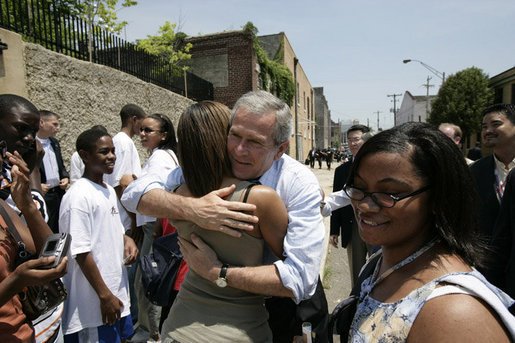
Bush and Koizumi didn’t just go to Graceland on Friday, but also to the National Civil Rights Museum, where he decided to try out a “replacement” for Condi, if you know what I mean. Dude, that is so, so wrong.
Saturday, July 01, 2006
More words to add to the 999,850 George Bush doesn’t know
Sen. Ted Stevens (R-Senile Dementia) explains how the internet works (evidently it’s a series of tubes) and why he won’t vote for Net Neutrality (because someone sent him an internet and it took several days to reach him).
Time magazine has an article about prisoners and hunger-strikes in Guantanamo, which explains why I’ve been getting all those hits from people googling “padded cell on wheels” today (this February post, which has pictures of the contraption). Readers of this blog will find nothing new in the article, and a certain amount of laziness (it says that in the “1980s,” “several” IRA prisoners hunger struck and a “handful” died). So why am I mentioning it? Er, good question. Moving on...
I’ve been thinking about the word “arrest.” A couple of days ago, Eli at LeftI made a point that I’ve made before, in relation to the actions of both Israelis in Palestine and Americans in Iraq, that they aren’t “arresting” people but capturing or seizing or kidnapping them, because arrests are done under some system of law. Suskind’s book mentioned parenthetically that when thousands of Arabs & Muslims were rounded up in the US after 9/11, “it was clear that the ratio of arrest to prosecution would be more out of sync than at any time in [FBI] history.” It occurred to me that the purpose of arrest had changed to such an extent that it did violence to the English language and to the concept of a rule of law to continue to use the word. If an arrest is no longer a preliminary to prosecution, it becomes an end in itself. The end is not the law, and the “law enforcement” agencies are no longer about enforcing laws. Police without law is the definition of a police state. Maybe the FBI needs breaking up if it is to be both a law-enforcement agency and a secret police.
Also, someone should revive “Arrested Development.” That was a good show.
A good WaPo Style Invitational, suggestions for the one millionth word in the English language. Some of the entries:
Percycution: Giving your child a name he will hate for the rest of his life.
Martyration: A request for only 36 virgins in paradise.
Achoodication: Trying to determine whether you have to say "bless you" after someone’s second sneeze.
Banglion: The primitive neural structure constituting 90 percent of the male brain.
Codgertation: A man’s realization that with a certain saying, thought or action, he has turned into his father.
Immigaytion: The GOP’s two-pronged fear strategy: "It’s two, two, two horrors in one!"
Racquisition: Implant surgery.
Regattacotillion: A vocabulary word designed solely to discriminate against minorities on standardized tests.
Regeorgitation: When the vending machine spits back your dollar bill.
No exit?
I’m not sure what Israel’s exit strategy is. Israel is entirely capable of kidnapping people explicitly for the purpose of exchanging them for captured Israeli military personnel (as in the case of Ron Arad), but it claims that the seizing of 8 Palestinian cabinet officials and however many MPs is not to swap them for Shalit, but because they’re terrorists. They were all taken in for questioning. Israel is evidently willing to... well, you don’t need me to list all the things they’ve done to Gazans... but not willing to admit to having responded to hostage-taking by taking hostages. Or something; trying to work out their logic makes me queasy. But if Israel won’t admit to seizing them in order to exchange them for Shalit, how can it manage the logistics of actually making that exchange?
The kidnappers, who keep making demands they can’t expect to be met, don’t seem to have a viable exit strategy either. So this should all turn out well.
A little detail from the WaPo: the Gaza power plant was ensured by the United States government, for $48 million.
The kidnappers, who keep making demands they can’t expect to be met, don’t seem to have a viable exit strategy either. So this should all turn out well.
A little detail from the WaPo: the Gaza power plant was ensured by the United States government, for $48 million.
Friday, June 30, 2006
Welcome to my blog: providing you with a kind of information radar to better understand the information battlespace
Cecilia Fire Thunder, the Sioux council president who offered to host an abortion clinic on her reservation in response to the SD abortion ban, has been impeached by the council for going beyond her authority.
The military tribunals at Guantanamo are supposed to contact witnesses who prisoners wish to call. They don’t. They make minimal or no effort to find them, and have never flown a witness in to testify. In one case, the Guardian found all 4 witnesses an Afghan prisoner wanted in 3 days (one was dead, one worked for Karzai, one is teaching in Washington DC). It’s called Google, baby.
Of course the Pentagon may be a little behind the curve on such things. It just launched a three-year, $450,000 study to figure out just what these “blog” things are, anyway. Says one guy associated with the project, “Our research goal is to provide the warfighter with a kind of information radar to better understand the information battlespace.” Hey, don’t laugh, he figured out how to make money off of blogs.
Russia is holding up the paper work of 40 foreign NGOs forced to “register” under new laws. Also, the Duma has passed (in its first reading) a bill banning “extremism,” which is defined as “interfering with the legal duties of organs of state authorities,” whatever that means (whatever Putin wants it to mean, of course), or “public slander directed toward figures fulfilling the state duties of the Russian Federation.” Journalists could be imprisoned for 3 years for that and their papers closed down. Political parties could be dissolved for it. Further along is a bill to scrap the “none of the above” option on Russian ballots that made them so much fun (candidates had to win 50% of the total vote).
A “Suskind offering”: Ron Suskind’s The One Percent Doctrine
I’ve finished Ron Suskind’s The One Percent Doctrine: Deep Inside America’s Pursuit of Its Enemies Since 9/11, and I’m not overwhelmed, more average-to-middling-whelmed (but if you still want to buy it after reading my review, do click here for my Powell’s link or here for my Amazon.com link. I get like 80¢ if you do. Or try your public library; I had this copy 3 days after I put a hold on it).
It’s a 350-page book that would have been better, if less lucrative, as a long New Yorker article. Like other books by reporters, it’s hard to judge how seriously to take its revelations without knowing who his sources are, and indeed who his sources aren’t – his insights into the thinking of Acting President Cheney may be the most important part of the book, but I’ll bet he wasn’t able to interview the man.
(I wrote that part last night. Today the Columbia Journalism Review website has an interview with him, and dear God what a self-important, pompous man he is. I couldn’t have brought myself to read the book if I’d read that interview first. He admits that the reader must take on faith that he has talked with enough of the right anonymous people and that he is able to take account of their biases and agendas and get the story right. But, dammit, people love and trust him, he says: “I think over time readers are saying, okay, this is a Suskind offering, this is what he does. It’s more vivid, it moves.” Now how you can trust that his quotes from Bush and Cheney are accurate when he thinks that that’s what his readers are saying? I don’t think he realizes that the trust he’s asking us to place in his judgment and his character exactly mirrors the trust Bush demands as his due.)
The book’s title refers to the belief among the Bushies that the stakes are so high in The War Against Terror (TWAT) that it is permissible to act to prevent events that there is very little proof will actually happen, such as Pakistan’s A.Q. Khan network passing nuclear technology to Al Qaida. Can’t have the smoking gun be a mushroom cloud, and all that. “Suspicion... became the threshold for action.” Suskind seems to have spoken mostly with CIA sources, who are interested in reasserting the importance of factual analysis and, let’s face it, in covering their asses.
By the way, the book’s famous Bush quote, after Tenet sent a briefer to Crawford in August 2001 to make sure Bush got the point that bin Laden was determined to attack inside the United States, “All right, you’ve covered your ass, now”: the real significance isn’t just that Bush dismissed it, but that for him, the point of intelligence briefings wasn’t to provide a basis for action; rather, that he considered them a form of bureaucratic ass-covering.
The most interesting thing about the book is the way in which 1) Cheney’s plans, dating back to the Ford administration, to strengthen the executive branch, 2) Bush’s intellectual laziness, and 3) the “new type of war” against shadowy terrorists, all came together to reinforce each other and create the new model of government we have today. Suskind writes,
The Cheney Doctrine released George W. Bush from his area of greatest weakness – the analytical abilities so prized in America’s professional class – and freed his decision-making to rely on impulse and improvisation to a degree that was without precedent for a modern president. Cheney essentially crafted a platform, an architecture, for Bush to be Bush, while still being President.The Cheney Doctrine – “It’s not about our analysis, or finding a preponderance of evidence. It’s about our response.” (that’s another maybe-quote) – is a perfect fit with a president who’s all about response and not at all about analysis, but it was The War Against Terror (TWAT) that raised the stakes and the uncertainty and paranoia and fear so that that recklessness could seem like a reasonable response.
On the one hand, crucial facts were routinely, Suskind says, kept away from Bush by Cheney, so that Bush could stick to the agreed narrative in public with plausible deniability and without being confused by the facts. Suskind, in another significant-if-true revelation, says that when Bush met with Saudi Crown Prince Abdullah in April 2002 to try to get Saudi Arabia to cooperate against Al Qaida, he hadn’t seen, and evidently didn’t know about the existence of, the prince’s set of demands, mostly relating to Israel, because Cheney had diverted them to his office. The prince went away rather confused.
There many interesting things in the book, and fragments of interesting things, including a discussion of how to get authoritarian rulers (like Gadhafi) to do what the US wants, when their power depends on not losing face. We have a terrorist policy, Suskind says, but not a dictator policy. And there are many of those significant-if-true quotes and facts which I simply don’t know how to use because I’m not inclined to put blind trust in Suskind. Like a George Bush speech, it’s likely to be believed by the sorts of people who are inclined to believe it, but not to convince anyone else.

Thursday, June 29, 2006
It was not always a given that the United States and America would have a close relationship
Bush thinks there is peace in southern Sudan (not Darfur). Told by the BBC’s Sudan reporter that the 2005 peace accord was not being honored by the government, he said, “That is not the information I’m getting.” That’s because it wasn’t extensively covered by Teen People magazine.
Salon finds proof of what Jane Mayer wrote last year (which they mentioned but didn’t link – bad Salon!), that the Pentagon’s how-to-survive-torture class was also used to train Guantanamo interrogators.
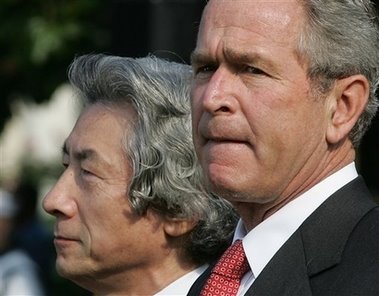
Bush met with Japanese Prime Minister Koizumi today. Bush told him “it was not always a given that the United States and America [sic] would have a close relationship.” Indeed, some would call the relationship between the United States and America an abusive relationship.
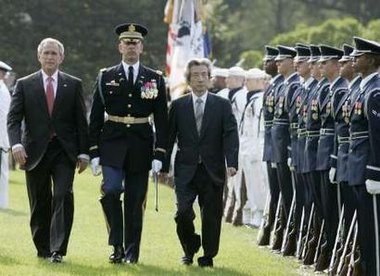
Here’s how Bush spun Japan’s decision to pull its troops out of Iraq: “And they’re able to leave because they did such a good job.”

He talked about how he’d met a Japanese woman whose daughter had been abducted by the North Koreans. “It also reminded me about the nature of the regime -- what kind of regime would kidnap people, just take them off offshore, you know”. Um, hello? Guantanamo?
Subscribe to:
Posts (Atom)

